Restaurant owners will open their monthly P&L reports, and look at the sales, and then go to the bottom of the report and close the report.
Sound familiar?
If only those two numbers are scrutinized, the report’s true value is not realized.
This shouldn’t force them to be more dependent on an accounting company. They should have confidence in their own numbers. It doesn’t require an expert in accounting or spend at night filling out invoices. It is important to know how profit has changed in relation to labor and food costs, and the other questions that must be addressed in the coming week.
Bookkeeping Chef’s goal is to automate bookkeeping chores that do not require the attention of restaurant owners while also providing them with clearer financial data they can utilize.
You must begin looking at Weekly Numbers and not just month-end numbers.
Restaurants aren’t operating on the basis of a monthly. The managers plan the work for the week. The chef placed an order for food today. Vendors change prices now.
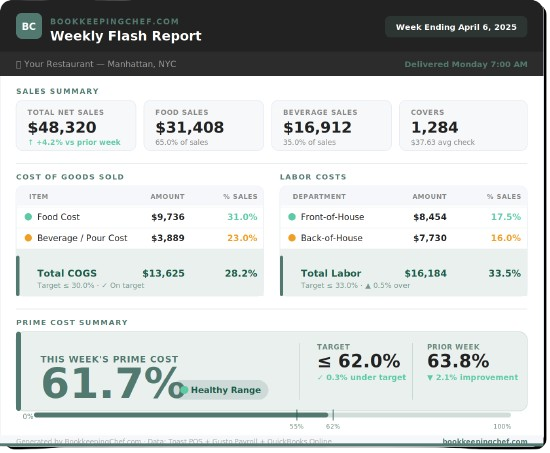
Bookkeeping Chef’s weekly Prime-cost reports are provided alongside the financial statements for the month.
Prime cost is the sum of two key aspects that can be easily relocated in a food service establishment: the price of the food sold, and the cost of labor. According to the data published by the Bookkeeping Chef prime costs account for around 60% of restaurant sales.
Take a look at a scenario where sales aren’t even changing however, the cost of prime services are increasing. That percentage alone doesn’t provide the solution. It gives the person in charge a reason to do some research.
Was there an increase in the amount of time worked? Was there overtime? Did food prices change? A vendor’s invoice was abnormally high. Does the mix of sales changed?
That is far more useful than finding the same problem two weeks later.
Automate repetitive work
Self-bookkeeping doesn’t mean manually transposing POS figures into spreadsheets.
Automating restaurant bookkeeping can help in the repetitive movement of financial data. The service can connect to systems such as POS as well as QuickBooks, payroll vendor platforms inventory management and recipe management, and tools for AP/payment.
Automating for the sake automated is not the aim.
It is to reduce manual data entry, and keep financial records updated so that owners have the ability to spend time reviewing data rather than gathering it.
This leads to a different style of bookkeeping for restaurants. technology is able to handle more mechanics, while the owner stays active in the financial aspect.
Learn to Ask the P&L Better Questions
A P&L is less daunting when you stop thinking of it as an accounting exam.
Begin with the sales. Begin with sales. Compare the food and drink performance. Think about the labor. Continue to reduce your operating costs.
Also, you should compare the time periods.
If sales improved but profit did not, something in between those two lines changed. What was the result when food prices went up? If labor percentage moved in the past, look at sales and staffing activity. Examine any figures that appear odd rather than just assuming that the restaurant experienced a poor week.
Bookkeeping Chef can provide monthly P&Ls that are finalized in five business days. The owners are able to look over the company’s performance without having to wait for months to receive financial statements.
For owners searching bookkeeping restaurant solutions, speed is useful but understanding is the bigger objective.
It’s not necessary to DIY everything.
There is a middle ground between handing the entire financial responsibility to another and being your own full-time bookkeeper.
Owners can remain active without having to perform each accounting task.
This could include making use of automated systems to manage information flow, reviewing an annual P&L and a weekly report on the primary costs and asking questions in the event that an unexpected event occurs.
The bookkeeping services of restaurants that specialize in the restaurant industry can assist owners comprehend the significance of reports by arranging the books and keeping them organized.
There is a good chance to get an accountant that can do all the duties.
An owner can have a conversation with an P&L regarding the company.
The objective of financial independence isn’t to create additional reports, but to be able to live a life of financial freedom.
Restaurants already produce huge quantities of data. A different dashboard won’t be as effective.
If an operator can look at the weekly prime cost report and see that something has changed, they are able to then review their P&L to determine what requires additional investigation.
Bookkeeping Chef’s approach combines restaurant financial support, weekly reports and automated bookkeeping in restaurants to accomplish this.
Automate repetitive tasks. Check your prime costs every week. Know the language that is used in your P&L.
There is no need to become an accountant.
Owners who know the financial aspect of their restaurants are able to make better choices.